
Knife And Prep / Core skill
How to dice an onion without stress
A step-by-step beginner guide to cutting onion pieces that cook evenly, without worrying about chef perfection.
How to use this guide as a complete beginner
Before cutting, make the board stable, dry your hands, clear wrappers and bowls away from the knife area, and create a flat side on round food where possible. A calm setup is part of the technique, not a separate chore.
Look for food that stays still, fingers tucked back, and pieces that are close enough in size to cook evenly. You should feel in control of the knife. If you feel rushed, the pieces are too small or the food is moving too much.
Practise slowly on one ingredient. Stop between cuts if you need to reset your hand position. Speed is not the beginner goal; repeatable, safe movement is.
Go slowly enough to notice
Speed hides information. The first few attempts are for seeing the change, hearing the sound, naming the texture and learning what happens when you adjust.
Use the image as a checkpoint
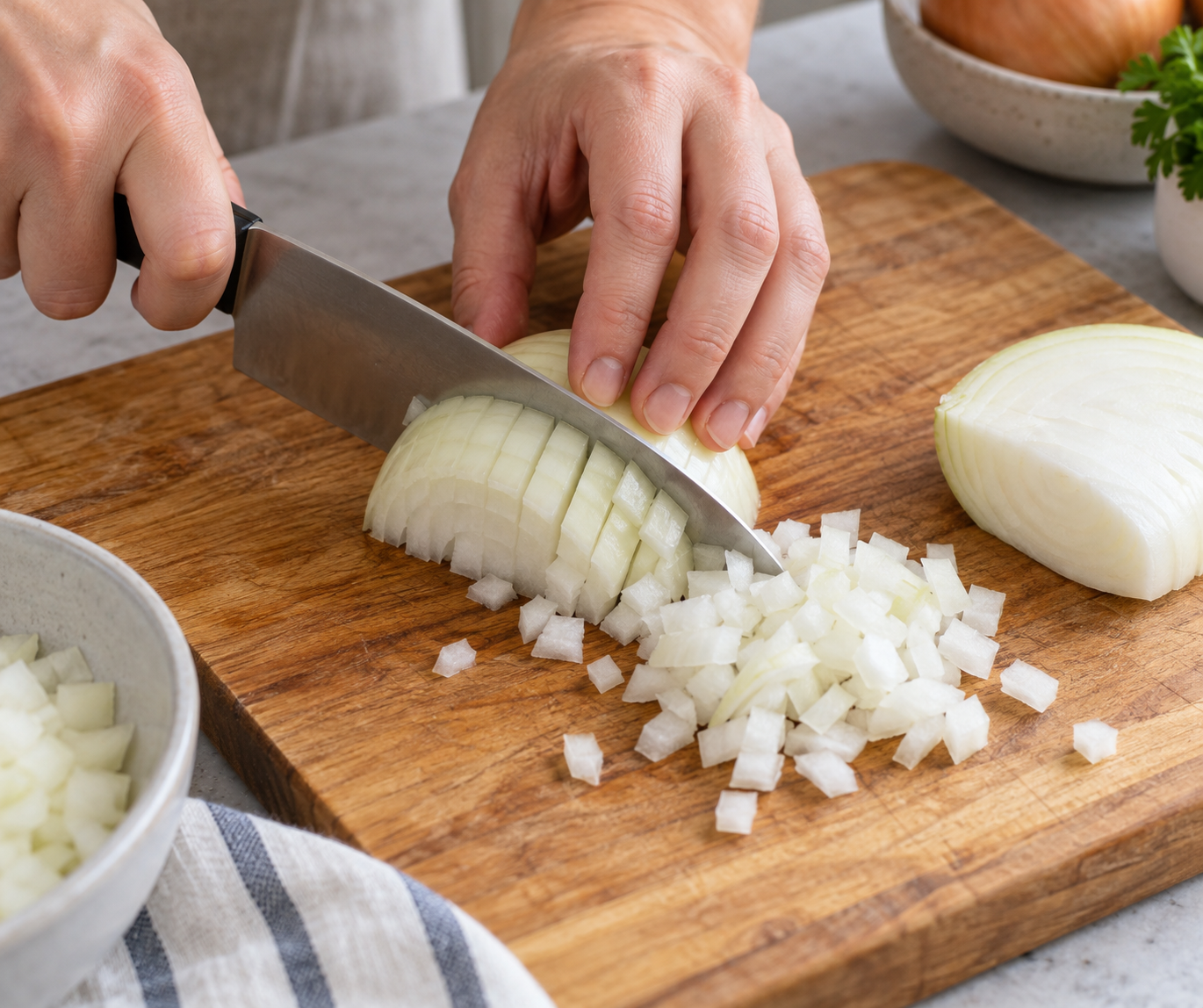
The linked KINALO image is not decoration. Compare it with your pan, board, bowl or tool so you know what stage you are looking for.
Good enough counts
Beginner cooking improves through repeatable attempts. If the food is usable and you learned the cue, the guide has done its job.
First-attempt checklist
Read the whole guide once before starting, then choose the smallest useful version of the task. Put the tools and ingredients where you can reach them. Decide what you will watch for first, such as colour, sound, texture, thickness, smell or how easily food moves.
During the attempt, change only one thing at a time. If the heat feels wrong, fix the heat before adding more ingredients. If the texture feels wrong, name the texture before trying to correct the flavour. This keeps the lesson clear.
Afterwards, write down one sentence: what worked, what changed too quickly, or what you would do earlier next time. That note matters more than a perfect result because it turns one cooking attempt into the next useful attempt.
If you only remember one thing, remember the cue rather than the instruction. Recipes tell you what to do; cooking confidence comes from recognising what is happening. Once you can name the cue, you can slow down, adjust and recover with less guesswork next time.
What dicing means
Dicing means cutting food into small pieces. Recipes use diced onion because small pieces soften, sweeten and disappear into sauces more easily than big chunks.
The goal is not perfect cubes. The goal is pieces that are similar enough to cook at about the same speed.
Before the knife touches the onion
- Use a board that does not slide.
- Cut the onion in half from root to tip so each half has a flat side.
- Peel away the papery skin.
- Keep the flat side down on the board.
- Work slowly enough that your guide hand stays in the claw position.
The simple beginner method
- Slice the onion half lengthways into strips, stopping before the root if that helps hold it together.
- Turn the onion and cut across those strips.
- Gather larger loose pieces and cut them again if needed.
- Leave tiny awkward end pieces aside if they feel unsafe. Good cooking does not require risking your fingers.
What size should the pieces be
For sauces, soups, chilli and curry bases, aim for pieces roughly the size of a small fingernail. Bigger pieces are fine for tray bakes or stews. Smaller pieces soften faster but can catch and burn sooner.
If your onion pieces are uneven, cook them gently. The tiny bits will soften first and the larger pieces will need a little more time.
Practice task
Dice one onion, then soften it in a pan with a little oil and a pinch of salt. Watch it change from sharp and white to glossy, soft and sweeter-smelling. That change is the real lesson.